YUNGABURRA HERITAGE VILLAGE
Butcher’s Shop
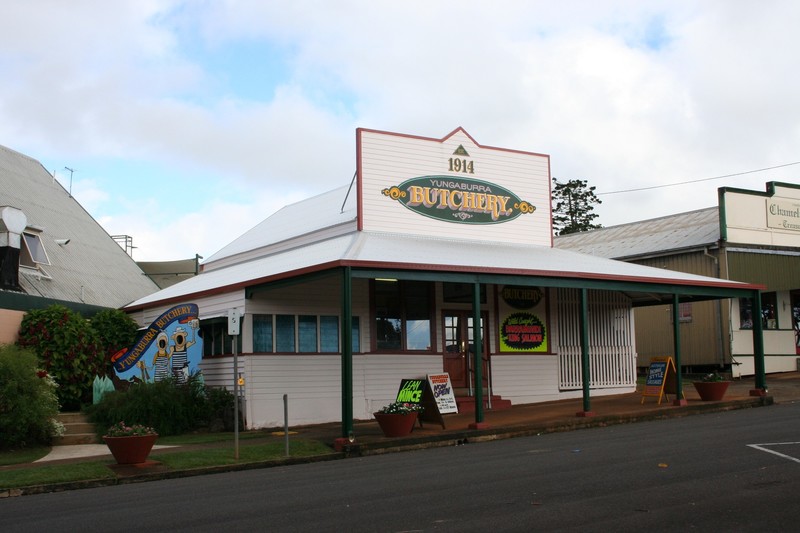
This shop has always been a butchery and is believed to have been built in 1922 for the Estate of HS Williams, which developed several businesses on land close to the railway station at Yungaburra in the 1920s.
The first Europeans on the Atherton Tablelands were engaged in timbergetting and mining, but the rich soil and cool climate were thought particularly suitable for the development of agriculture. In 1885 a Village Settlement scheme was introduced which offered settlers 40 acre farm blocks with home sites clustered as a village. In 1888 a village settlement was laid out at Allumbah Pocket, later to become Yungaburra. At the same time a railway from the port of Cairns to the Tableland was begun, although it took far longer to reach its objective than originally envisaged. The first farms at Allumbah were taken up in 1891, though the scheme proved unsuccessful. The railway reached Mareeba in 1895 and Atherton in 1903, greatly improving access to the area. Following new Land Acts in the early 1900s to encourage closer settlement which had more practical requirements, more people took up land around Allumbah. The land on which the butcher shop was later built, and which was to become the commercial heart of Yungaburra, was part of an Agricultural Farms selected by George O’Donnell in 1899.
In 1900 the land was sold to George Wedderburn and subdivided into numerous small blocks in 1910. Six acres were acquired by the Railway Commissioner and the position of the new railway station caused a geographic shift in focus from the original settlement which was located towards the north west of the new commercial centre. Buildings were constructed or relocated near the railway. Two of the blocks positioned close to the station were purchased in 1911 by AS and FC Williams for a new hotel. The Williams family’s interest in this area grew as they acquired land adjoining the hotel over the next few years.
H.S. Williams had arrived in Australia in the 1860s and worked in a number of occupations before taking up land at Scrubby Creek on the Tablelands. After losing his dairy cattle to tick in 1895, Williams turned to business and ran a store and butchery at Scrubby Creek and the Carriers Arms hotel at Carrington, He then acquired land in the original Allumbah settlement in 1898 and established a store.
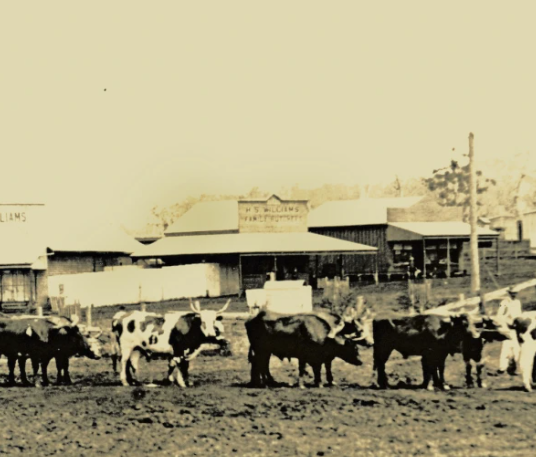
He was killed in an accident in 1905, but the family business was continued by his sons under the name of ‘Estate H.S. Williams’. In 1907 they established a shanty hotel in Allumbah to serve packers and the navvies constructing the railway inching its way towards the town. In 1910, the railway line reached the settlement, which had been renamed Yungaburra to avoid confusion with another similarly named town. The railway link triggered a period of rapid development with the construction of a saw mill, a store and a large hotel for the Williams family opposite the railway station and a number of shops and houses. In 1911, Eacham Shire was formed.
In the 1923 post office directory the Estate of H.S. Williams is listed as operating a store, butchers and bakery and they presumably built these businesses about the same time in anticipation of the road link from Gordonvale, which had been under construction since 1920. The store was between the butchery and the hotel, but has since been demolished. In 1926 the Gillies Highway was opened and the role of Yungaburra as a gateway to the natural attractions of the Tablelands created a second period of development in the town due to the blossoming tourist trade to the nearby lakes.
In 1975 the butchery was sold and changed hands several times in the late 1970s and 80s before being purchased by the current butcher in 1992. The shop has modern equipment and interior finishes but its general appearance and functional layout appears to be substantially unchanged.